Monday, 14 October 2013

Water on celestial bodies across the Solar System.

Does water exist anywhere else in the solar system?
The answer is Yes!
A mighty yes!

About 70% of our planet Earth consists of water. It is said that life was first originated in water.
And, the possibility of finding water on other planets in the solar system would lead to another question.
Is there life else where in the Universe.
The answer is obviously yes. But, let's get back to the topic.

It has been observed that surface water once covered large areas of surface of planets, Venus and Mars.
The planet Mars has huge ridges in the surface indicating that Mars once had huge river systems.
Mars is said to have polar ice-caps where water is found in a solid form.

The next possibility of finding water in our solar system is in a moon of our biggest planet, Jupiter.
Yes.
Europa, the moon of Jupiter is said to have huge deposits of water.
Europa is said to have more water than the water present in the oceans and seas of earth.
Yep.
Amazing, ain't it?

Let's come to the gas giants, Jupiter and Saturn.
Neptune is said to have plenty of ice and water vapour.
But, the chances of water to be present in a liquid form given that pressure and temperature is quite less.
Jupiter, with it's massive size is said to comprise of many layers.
It is possible that the conditions on one of those layers may resemble the conditions on our planet and that water could exist there.


Now, the ice-giants.
Yep, Ice giants.
Uranus and Neptune are the ice-giants of our solar system. They're made up of methane, ammonia and water which are frozen.It is said that the middle layers may be actually vast layers of water and ammonia.

Oh and we're not done yet.
What about the comets and asteroids? Ever wondered what they're made up of?
Answer : Ice.
Yep, ice. Ceres, a lone dwarf planet might contain water-ammonia ocean beneath it's icy exterior.
So, we're not just the only ones to have water.

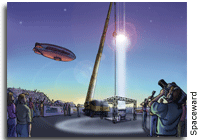
Space Elevator!

TADA!!!
Let me present you with the space elevator!!!


Too cool to believe? Say what, it's gonna work.

Yep.
The space elevator as it's name says is a type of space-transportation system. The main component is a ribbon like cable called the tether anchored to the surface and going up into the space.Cool, huh?
What's a space elevator gonna be used for?
It's obviously gonna be used to transport objects from earth directly into space or orbit without having to worry about the fuel consumption in rockets.
Yep, that's right.
It's gonna have a cable attached to the surface near the equator and the other end would be beyond the geostationary orbit or like above 36,000 km altitude.
Gravity would be stronger at the lower end and the outward centrifugal force which is stronger in the upper end would result in the cable being help up, under tension and be stable over a single point on the Earth.
One deployed, the tether would be ascended repeatedly by mechanical means to orbit, and return to the surface from the orbit.

Who first came up with the idea of a space elevator? 

 It was Konstantin Tsiolkovsky.He proposed a free-standing tower from surface of Earth to the height of a geostationary orbit.But the structure of Tsiolkovsky would collapse under the immense pressure as it's weight would be supported from below. Since 1959, most ideas for space elevators focrused on purely tensile structures with a weight of the system to be help from above.
But now, with increase in technology and information about the space, scientists are working on materials for the tether (The cable, like I earlier mentioned). They need strong and light material to build elevator and are now considering the use of carbon nanotubes or boron nitride nanotube based materials as the tensile element to design tether.

Are space elevators possible in celestial bodies across our solar system? 


Let's say we colonise moon and mars.
They've got considerably less gravity.So, we don't have to use carbon nanotubes or boron nitride nanotubes over there.
We just have to work with substances which are capable of holding up the elevator without worrying about the high gravity.

Which substance can be used in the space elevators on bodies like Mars and Moon?


For locations in the solar system with weaker gravity than Earth's require materials with a lesser strength-to-density for the tether. Kevlar could be a possible choice as it is strong and light enough for the conditions in those planets.


What about the money used in the project? 


Economics. Yep, one of the most important concept in all the major projects.
A space elevator would be used as a substitute to modern day rockets. They're said to recude the cost and work-load used in sending rockets to space.
If they're designed to reduce the cost of sending in rockets to outer space, they must be considerably cheap.
Transfering an average rocket to a geostationary orbit  (According to NASA) would be an estimate of about 450 million.
But with the space lift, it's just 220 USD per kg (For a normal launch as per 2,000 conventions) when compared to the whooping 25,000 USD per kg when using a rocket.
So, by all means, this project would be about 6.2 billion (According to the 2004, 55th International Astronomical Congress)
Carbon Nanotubes for tether.


Tuesday, 1 October 2013

Sirius or Dog Star.


Sirius is the brightest star in the night sky. It is almost twice as bright as Canopus, The next brightest star.The name "Sirius" is derived from Ancient Greek. What we see with our naked eye as a single star is actually a binary star system consisting of two stars, Sirius A which is a white main-sequence star of spectral type A1V and a faint white dwarf companion of spectral type DA2 called Sirius B. The distance between Sirius A and Sirius B is about 8.1 and 31.5 Astronomical Units.Sirius, is known as "Dog Star" which reflects its prominence in its constellation Cains Major.Sirius is at a distance of 2.6 Parsecs ( 8.6 Light Years ) as determined by the Hipparchus Astrometry satellite. It's one of the Earth's near neighbours. Sirius is gradually moving closer to the Solar System so it will slightly increase in brightness over the next 60,000 years. Then, It's distance will recede but it will continue to be the brightest star in the Earth's sky for the next 210,000 years.Sirius A is about twice the size of of our Sun and about 25 times brighter. The age of the system is around 200 to 300 million years. The system was originally of two bright bluish stars.Sirius B turned into a red gaint and is turned into its current state as a white dwarf around 120 million years ago.


Thursday, 26 September 2013

Light was stopped.

The speed of light is a constant. It travels at an amazing 186,282 miles per second (299,791km/sec). However, this speed only applies in a perfect vacuum where light will not encounter any other atoms. In a non-vacuum (which exists pretty much everywhere), bits of light smash into other objects. These objects absorb the photon and then re-emit it. In this respect, the slowing of light is an illusion. The photons still travel from at the same speed, but they make a few stops along the way as they are absorbed and refracted by various atoms. And light is absorbed and emitted more slowly through certain substances. For example, diamond makes light travel from A to B significantly slower.

But we can use these principles to essentially stop light. In all likeliness, many of you have already heard about the scientists in Germany who stopped light for a full minute. I’d like to offer a breakdown of how they accomplished this feat.

To begin with, the scientists took an opaque crystal (something that light is not able to penetrate) and fired lasers into it. This caused the quantum states of atoms within the crystal to become disturbed. Ultimately, the scientists were able to make it so that a specific frequency of light could pass through this previously opaque object by altering the crystal in such a say so that the atoms within it had two quantum states.


Next, the researchers shot a laser beam (which corresponded to the specific frequency) through the newly transparent region. Then they turned off the laser beam that was altering the quantum states of the atoms within the crystal. This made the material once more opaque. The result of this was that the second laser beam was halted within the material. The beam was held in place for a whole minute. They were also able to store and retrieve an image using the same technique.

Of course, things are not quite this simple. For starters, the crystal that was frozen to less than negative 450 degrees Fahrenheit (-267C). But the aforementioned is a basic breakdown of the technique. For those interested in more technical information, see this source. Here, I will offer a brief passage which conveys the specifics:

“Light can be slowed down to the point that it comes to a halt: by switching off the control beam when the light is within the sample, the photons can be converted into collective atomic spin excitations (so called spin waves). The spin waves can be stored in the atoms for as long as the coherence between the two spin levels survives, before being converted back into light by turning on the control pulse again. The scheme thus allows the coherent storage and retrieval of light. How long can the storage time be? Since the light is stored in atomic coherences, the limit is given by T2, quantifying the lifetime of the coherence between the two relevant atomic spin states (how long the two spin states can remain in a coherent superposition).”

Sunday, 22 September 2013

Facts about our Moon :

1)First, how was the moon created?The Moon was created when a huge rock (About the size of the Planet Mars) hit Earth around the time of the formation of Solar System (Around 4.5 Billion Years ago).
2)Do we have just one moon?
No, Not just one.It's two, actually. Scientists have discovered a 3 mile asteroid thats caught in the earths gravitational field and is orbitting the earth. It takes 770 years for this moon to complete it's orbitting around earth.
3)Why does moon have craters? 
The moon is heavily cratered because of the high collisions of space rocks on the surface of moon.The craters don't erode because the moon has no atmosphere, so no wind or rain, so no surface erosion and not many earthquakes or volcanoes too.

4)Shape of Moon?
The Moon has actually the shape of an egg.

Saturday, 21 September 2013

Relative Theory :

So, all of you know the most famous work of Albert Einstein?
E=MC^2.
Energy = Mass multiplied by square of speed of light.

But that isn't the only famous work of Einstein.
He also gave the Theory of Relativity.


The Theory of Relativity :

The Theory of Relativity has basically two theories : 1) Special Relativity and 2) General Relativity.
Main points :
Measurements of various quantities are relative to the velocities of observers.In particular, space and time can dilate.Spacetime : Space and time should be considered together and in relation to eachother.Speed of light is invariant, the same for all observers.

The theory of relativity was representative of more than a single new physical theory. Special relativity applies to elementary particles and their interactions, whereas general relativity applies to cosmological and astrophysical realm, including astronomy.Special Relativity was accepted and used as a necessary tool for theorists in the new fields of atomic physics, nuclear physics and quantum mechanics.


Friday, 20 September 2013

Massive Blackhole found.

Astronomers have discovered what may be the most massive black hole ever known in a small galaxy about 250 million light-years from Earth, scientists say.
The supermassive black hole has a mass equivalent to 17 billion suns and is located inside the galaxy NGC 1277 in the constellation Perseus. It makes up about 14 percent of its host galaxy's mass, compared with the 0.1 percent a normal black hole would represent, scientists said.
"This is a really oddball galaxy," said study team member Karl Gebhardt of the University of Texas at Austin in a statement. "It's almost all black hole. This could be the first object in a new class of galaxy-black hole systems."
The giant black hole is about 11 times as wide as the orbit of Neptune around our sun, researchers said. The mass is so far above normal that the scientists took a year to double-check and submit their research paper for publication, according to the study's lead author, Remco van den Bosch.
"The first time I calculated it, I thought I must have done something wrong. We tried it again with the same instrument, then a different instrument," van den Bosch, an astronomer at Germany's Max Planck Institute for Astronomy, told SPACE.com. "Then I thought, 'Maybe something else is happening.'" 
Astronomers typically believe that the size of the central part of a galaxy, and the black hole inside of it, are linked. But the vastly different proportions seen in NGC 1277 are calling that into question.
NGC 1277's black hole could be many times more massive than its largest known competitor, which is estimated but not confirmed to be between 6 billion and 37 billion solar masses in size.It makes up about 59 percent of its host galaxy's central mass - the bulge of stars at the core. The object's closest competitor is in the galaxy NGC 4486B, whose black hole takes up 11 percent of that galaxy's central bulge mass.  
 However, van den Bosch's team says it has also spotted five other galaxies near NGC 1277 that look about the same, and may also harbor gigantic black holes inside of them.
Van den Bosch said his team discovered the mega black holes during a survey to seek "the biggest black holes we could find."
The astronomers analyzed the light coming from 700 galaxies, using an immense light-gathering telescope: the Hobby-Eberly Telescope at the University of Texas at Austin's Mcdonald Observatory.
From that large survey, they found six galaxies with stars and other objects whipping about inside of them at unusually high average speeds — more than 218 miles a second (350 kilometers). The galaxies also were small, at less than 9,784 light-years across.
Suspecting the speed and size measurements meant massive black holes lay inside these galaxies, the team used Hubble Space Telescope archival data of NGC 1277 and discovered the large black hole.
The team also noted that NGC 1277 has only old stars inside it. The youngest stars in the galaxy are 8 billion years old, almost twice the age of our sun.
Van den Bosch said he is curious to know if these large black holes only formed in the early years of the universe.
"It could just be this thing has been sitting around since the Big Bangand not done much since then," he said. "It might be a relic of what star formation and galactic formation looked like at that time."

Thursday, 12 September 2013

Stephen Hawkings.


Heyo Guys.
Today, I'm gonna post about the super genius, Stephen Hawkings.
Stephen Willian Hawking, popularly known as just Stephen Hawkings was born on 8th of January, 1942.
Stephen Hawking is famously known for his book " A Brief History of Time"
His other significant works : Gravitational Singularities Theorems in the framework of General Relativity.
He also said that blackholes emit radiations. He named the radiations as "Hawking Radiations."
Stephen William Hawking worked as professor of Mathematics in the University of cambridge in the time period of 1979-2009.Despite being known for his extreme intelligence, he's also one of the most famous men to suffer a motor neuron disease : Amyotrophic Lateral Sclerosis.His only mode of speech is by a "Speech-generating-device". He is paralysed and can't speak without the help of the device.

Hawking's was also awarded the "Presidential Medal of Freedom" which is the highest civilian award in the United States.
Now, Hawking's is regarded as the most intelligent man on earth.But, during his schoolhood in Byron House School, he could not read and write properly.Stephen Hawking's studied in the reputed Oxford University.

Stephen Hawking trying out "Anti-Gravity"


 A Brief History of Time : 
In the book, Stephen Hawking's mostly concentrated on explaining the important subjects in cosmology and blackholes and the Big Bang.He even wrote about time travel and the possibilty of worm-holes.
That's all for now, folks.


Wednesday, 4 September 2013

Asteriod

Heyo guys.

So, do you guys wanna know what's an Asteroid?

Asteroids are minor planets (small Solar System bodies and dwarf planets) that are not comets, especially those of the inner Solar System. They have also been called planetoids, especially the larger ones. These terms have historically been applied to any astronomical object orbiting the Sun that did not show the disk of a planet and was not observed to have the characteristics of an active comet, but as small objects in the outer Solar System were discovered, their volatile-based surfaces were found to more closely resemble comets and so were often distinguished from traditional asteroids. Thus the term asteroid has come increasingly to refer specifically to the small bodies of the inner Solar System out to the orbit of Jupiter. They are grouped with the outer bodies—centaurs, Neptune trojans, and trans-Neptunian objects—as minor planets, which is the term preferred in astronomical circles.In this article the term "asteroid" refers to the minor planets of the inner Solar System.
There are millions of asteroids, many thought to be the shattered remnants of planetesimals, bodies within the young Sun's solar nebula that never grew large enough to become planets. The large majority of known asteroids orbit in the asteroid belt between the orbits of Mars and Jupiter or co-orbital with Jupiter (the Jupiter Trojans). However, other orbital families exist with significant populations, including the near-Earth asteroids. Individual asteroids are classified by their characteristicspectra, with the majority falling into three main groups: C-type, S-type, and M-type. These were named after and are generally identified with carbon-rich, stony, and metallic compositions, respectively.
Only one asteroid, 4 Vesta, which has a relatively reflective surface, is normally visible to the naked eye, and this only in very dark skies when it is favorably positioned. Rarely, small asteroids passing close to Earth may be naked-eye visible for a short time.

Tuesday, 3 September 2013

Origin of the Universe

Here's Abhishek again.


OK, now to the origin of the Universe.
Well, there are many theories for the origin on the Universe.
The most famous theory among them is The Big Bang Theory.

The Big Bang Theory : 


The Big Bang theory is the prevailing cosmological model that describes the early development of the Universe. According to the theory, the Big Bang occurred approximately 13.798 ± 0.037 billion years ago,which is thus considered the age of the universe expanding rapidly. After the initial expansion, the Universe cooled sufficiently to allow energy to be converted into various subatomic particles, including protons, neutrons, and electrons. Though simple atomic nuclei formed within the first three minutes after the Big Bang, thousands of years passed before the first electrically neutral atoms formed. The majority of atoms that were produced by the Big Bang are hydrogen, along with helium and traces of lithium. Giant clouds of these primordial elements later coalesced through gravity to form stars and galaxies, and the heavier elements were synthesized either within stars or during supernovae.
 At this time, the Universe was in an extremely hot and dense state and began 
The Big Bang is the scientific theory that is most consistent with observations of the past and present states of the universe, and it is widely accepted within the scientific community. It offers a comprehensive explanation for a broad range of observed phenomena, including the abundance of light elements, the cosmic microwave background, large scale structure, and the Hubble diagram. The core ideas of the Big Bang—the expansion, the early hot state, the formation of light elements, and the formation of galaxies—are derived from these and other observations. As the distance between galaxies increases today, in the past galaxies were closer together. The consequence of this is that the characteristics of the universe can be calculated in detail back in time to extreme densities and temperatures, while large particle accelerators replicate such conditions, resulting in confirmation and refinement of the details of the Big Bang model. On the other hand, these accelerators can only probe so far into high energy regimes, and astronomers are prevented from seeing the absolute earliest moments in the universe by various cosmological horizons. The earliest instant of the Big Bang expansion is still an area of open investigation. The Big Bang theory does not provide any explanation for the initial conditions of the universe; rather, it describes and explains the general evolution of the universe going forward from that point on.
Georges LemaĆ®tre first proposed what became the Big Bang theory in what he called his "hypothesis of the primeval atom". Over time, scientists built on his initial ideas to form the modern synthesis. The framework for the Big Bang model relies on Albert Einstein's general relativity and on simplifying assumptions such as homogeneity and isotropy of space. The governing equations were first formulated by Alexander Friedmann and similar solutions were worked on by Willem de Sitter. In 1929, Edwin Hubble discovered that the distances to far away galaxies were strongly correlated with their redshifts—an idea originally suggested by LemaĆ®tre in 1927. Hubble's observation was taken to indicate that all very distant galaxies and clusters have an apparent velocity directly away from our vantage point: the farther away, the higher the apparent velocity, regardless of direction.Assuming that we are not at the center of a giant explosion, the only remaining interpretation is that all observable regions of the universe are receding from each other.
While the scientific community was once divided between supporters of two different expanding universe theories—the Big Bang and the Steady State theory, observational confirmation of the Big Bang scenario came with the discovery of the cosmic microwave background radiation in 1964, and later when its spectrum (i.e., the amount of radiation measured at each wavelength) was found to match that of thermal radiation from a black body. Since then, astrophysicists have incorporated observational and theoretical additions into the Big Bang model, and its parametrization as the Lambda-CDM model serves as the framework for current investigations of theoretical cosmology.