Monday, 14 October 2013

Near Earth Objects (NEO)

A Near Earth Object is an object in the solar system whose orbit comes extremely close to Earth.
Near Earth Objects are of many types.
1)Near Earth Asteroids.
2)Near Earth Comets.
3)Near Earth Meteoroids.
4)A number of solar-orbiting spacecrafts.

Near Earth Asteroids or the NEA have orbits ranging from 0.983 to 1.3 AU away from the Sun.
When an NEA is detected, it is submiteted to the Minor Planet Center (Located at the Harvard-Smithsonian Center for Astrophysics) for cataloging. 
There is always a chance for Near Earth Asteroids to collide with Earth. NASA has a congressional mandate to catalogue all NEO's that are atleast 1 km wide as the impact of such an object would be catastrophic.As of Aug 2012, there have been 848 NEA's larger than 1 km and of  which 154 are potentially hazardous asteroids (PHA's). 

About 65 million years ago, an asteroid which was about 4-5 miles in diameter collided with Earth.
The collision generated immense heat and energy causing the end of the dinosaurs.
If such a collision happens again, it would generate such immense heat and energy causing a massive change in the climatic conditions.This would lead to a fall in the dominant species of the planet. Humans.
Yes. If an asteroid as big or bigger than that collides with Earth, that would be the end of the human legacy.

And, about a million NEO's are currently in space which can cause catastrophic damage.


These 11 Asteroids came seriously close to earth in the last year : 

1) 2013 RZ53, September 18, 2013
2)(52760) 1998 ML14, August 24, 20133)(277475) 2005 WK4, August 8, 2013
4)
2003 DZ15, July 30, 2013.
5)
2006 BL8, July 26, 20136)2013 LR6, June 8, 20137)2009 FE, June 4, 2013 8)(285263) 1998 QE2, May 29, 2013
9)
(7888) 1993 UC, March 20, 201310)2013 ET, March 9, 2013.
11)
2012 DA14, February 15, 2013


Pulsars :


A pulsar is a highly magnetized, rotating neutron star that emits a beam of electro-magnetic radiation. This radiation can only be observed when the beam of emission is pointed towards the earth.
A neutron star is pretty dense and has short-regular rotational periods.A pulsar gets it's name because it emits energy in the form of pulses and is short for "Pulsating star".


When and by who'm was the first pulsar discovered?


The  first pulsar was observed on November 28, 1967 by Jocelyn Bell Burnell and Antony Hewish.They observed pulses seperated by 1.33 seconds, originated from the same location on the sky.

Quasars :

A Quasar (Also known as a quasi-stellar radio source) is a very energetic and distant active galactic nucleus.
Quasars are super-insanely and extremely luminous!
They're super-amazingly bright. They were first identified as being high-redshift sources of electromagnetic energy, including radio waves and visible light, that were point like similar to stars rather than extended sources similar to galaxies.

A quasar is a compact region in the center of a massive galaxy that surrounds it's central super massive black hole.
It's size is like about 10-10,000 times the size of a Schwarzschild radius of a black hole
A quasar is powered by an accretion disc around the black hole. A quasar generates more energy than entire galaxies.

Scientists have found about 200,000 Quasars.
A quasar would shut down if the black hole near the center of the galaxy in which it resides is done with consuming everything in the host galaxy.


Earth's Magnetic Field :

Earth's geo-magnetic field is the magnetic field that extends from the Earth's inner core to where it meets the solar wind ( A flow or stream of highly-accelerated particles emanating from the Sun).
The range of Earth's magnetic field is about 25 to 65 micro-tesla(µT) which is about 0.25 to 0.65 Gauss.
The Earth's magnetic field is generated by the motion of molten iron alloys in the Earth's outer core (The geodynamo).
The North Magnetic Pole wanders off, but it does too slowly that we can use a simple compass for navigation.

Here comes the interesting part.
Over several thousand years, the Earth's geo-magnetic field reverses.Current North Pole becomes the south pole and our current south pole becomes the North pole.
Yep.
Geo-Magnetic Reversals occur once every several thousand years.


Why is the Magnetic Field so important? 
The magnetic field protects Earth from highly-accelerated charged particles like the electrons or the ions from the Sun.
Without the magnetic field, Earth would have been riddled by these particles and would the core of the earth would de-stabilise. The region over the ionosphere is called the magnetosphere, and extends several tens of thousands of kilometers into space. This region prevents the cosmic rays from entering into Earth.
Without the Magnetic field, the entire ionosphere would be stripped off taking away the Ozone layer too which would cause harmful UV rays to enter.


Declination from 1590-1990.

Solar Flares

A solar flare is a sudden brightening over the Sun's surface which releases immense energy!
An average solar flare is said to release about 6 x 10^25 joules of energy which is about a sixth of the total energy output of the sun each second.
Let's put that in normal words?
Imagine 160,000,000,000 megatons of TNT exploding right next to you.
Yep. That's the energy released in an average solar flare.  A solar flare is followed by a coronal mass ejection or a CME. The solar flare releases immense energy and also ejects clouds of electrons, ions and atoms through the corona of the sun into space which reach Earth in about two days time.

An average solar flare heats the solar-atmosphere by tens of millions of kelvin causing  the electrons, protons and the other heavier ions to accelerate at immense speed (Almost near the speed of light).
The X-rays and UV rays emitted by the solar flares can affect Earth's ionosphere and disrupt the long-range radio communications. 

When were solar flares first observed? 

Solar flares were first observed in the year 1859.

Who was the first people to observe a Solar Flare?
Richard Christopher Carrington and Richard Hodgson were the first people to observe a solar flare.
Richard Hodgson in 1859 observed localised visible brightenings of small areas within a sunspot group.
Stellar flares have also been observed on a variety of other stars.

Occurence of Solar Flares?
The occurence of a Solar Flare may vary from serveral times a day or to less than a week. 
Small Solar flares occur more frequently.
The most important question of all :

When and how do Solar Flares occur? 

Solar Flares occur when highly accelerated charged particles (Or say electrons) interact with the plasmic medium of the Sun.

Looks like that sums it up, peeps.

Water on celestial bodies across the Solar System.

Does water exist anywhere else in the solar system?
The answer is Yes!
A mighty yes!

About 70% of our planet Earth consists of water. It is said that life was first originated in water.
And, the possibility of finding water on other planets in the solar system would lead to another question.
Is there life else where in the Universe.
The answer is obviously yes. But, let's get back to the topic.

It has been observed that surface water once covered large areas of surface of planets, Venus and Mars.
The planet Mars has huge ridges in the surface indicating that Mars once had huge river systems.
Mars is said to have polar ice-caps where water is found in a solid form.

The next possibility of finding water in our solar system is in a moon of our biggest planet, Jupiter.
Yes.
Europa, the moon of Jupiter is said to have huge deposits of water.
Europa is said to have more water than the water present in the oceans and seas of earth.
Yep.
Amazing, ain't it?

Let's come to the gas giants, Jupiter and Saturn.
Neptune is said to have plenty of ice and water vapour.
But, the chances of water to be present in a liquid form given that pressure and temperature is quite less.
Jupiter, with it's massive size is said to comprise of many layers.
It is possible that the conditions on one of those layers may resemble the conditions on our planet and that water could exist there.


Now, the ice-giants.
Yep, Ice giants.
Uranus and Neptune are the ice-giants of our solar system. They're made up of methane, ammonia and water which are frozen.It is said that the middle layers may be actually vast layers of water and ammonia.

Oh and we're not done yet.
What about the comets and asteroids? Ever wondered what they're made up of?
Answer : Ice.
Yep, ice. Ceres, a lone dwarf planet might contain water-ammonia ocean beneath it's icy exterior.
So, we're not just the only ones to have water.

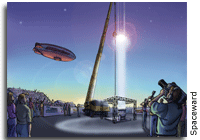
Space Elevator!

TADA!!!
Let me present you with the space elevator!!!


Too cool to believe? Say what, it's gonna work.

Yep.
The space elevator as it's name says is a type of space-transportation system. The main component is a ribbon like cable called the tether anchored to the surface and going up into the space.Cool, huh?
What's a space elevator gonna be used for?
It's obviously gonna be used to transport objects from earth directly into space or orbit without having to worry about the fuel consumption in rockets.
Yep, that's right.
It's gonna have a cable attached to the surface near the equator and the other end would be beyond the geostationary orbit or like above 36,000 km altitude.
Gravity would be stronger at the lower end and the outward centrifugal force which is stronger in the upper end would result in the cable being help up, under tension and be stable over a single point on the Earth.
One deployed, the tether would be ascended repeatedly by mechanical means to orbit, and return to the surface from the orbit.

Who first came up with the idea of a space elevator? 

 It was Konstantin Tsiolkovsky.He proposed a free-standing tower from surface of Earth to the height of a geostationary orbit.But the structure of Tsiolkovsky would collapse under the immense pressure as it's weight would be supported from below. Since 1959, most ideas for space elevators focrused on purely tensile structures with a weight of the system to be help from above.
But now, with increase in technology and information about the space, scientists are working on materials for the tether (The cable, like I earlier mentioned). They need strong and light material to build elevator and are now considering the use of carbon nanotubes or boron nitride nanotube based materials as the tensile element to design tether.

Are space elevators possible in celestial bodies across our solar system? 


Let's say we colonise moon and mars.
They've got considerably less gravity.So, we don't have to use carbon nanotubes or boron nitride nanotubes over there.
We just have to work with substances which are capable of holding up the elevator without worrying about the high gravity.

Which substance can be used in the space elevators on bodies like Mars and Moon?


For locations in the solar system with weaker gravity than Earth's require materials with a lesser strength-to-density for the tether. Kevlar could be a possible choice as it is strong and light enough for the conditions in those planets.


What about the money used in the project? 


Economics. Yep, one of the most important concept in all the major projects.
A space elevator would be used as a substitute to modern day rockets. They're said to recude the cost and work-load used in sending rockets to space.
If they're designed to reduce the cost of sending in rockets to outer space, they must be considerably cheap.
Transfering an average rocket to a geostationary orbit  (According to NASA) would be an estimate of about 450 million.
But with the space lift, it's just 220 USD per kg (For a normal launch as per 2,000 conventions) when compared to the whooping 25,000 USD per kg when using a rocket.
So, by all means, this project would be about 6.2 billion (According to the 2004, 55th International Astronomical Congress)
Carbon Nanotubes for tether.


Tuesday, 1 October 2013

Sirius or Dog Star.


Sirius is the brightest star in the night sky. It is almost twice as bright as Canopus, The next brightest star.The name "Sirius" is derived from Ancient Greek. What we see with our naked eye as a single star is actually a binary star system consisting of two stars, Sirius A which is a white main-sequence star of spectral type A1V and a faint white dwarf companion of spectral type DA2 called Sirius B. The distance between Sirius A and Sirius B is about 8.1 and 31.5 Astronomical Units.Sirius, is known as "Dog Star" which reflects its prominence in its constellation Cains Major.Sirius is at a distance of 2.6 Parsecs ( 8.6 Light Years ) as determined by the Hipparchus Astrometry satellite. It's one of the Earth's near neighbours. Sirius is gradually moving closer to the Solar System so it will slightly increase in brightness over the next 60,000 years. Then, It's distance will recede but it will continue to be the brightest star in the Earth's sky for the next 210,000 years.Sirius A is about twice the size of of our Sun and about 25 times brighter. The age of the system is around 200 to 300 million years. The system was originally of two bright bluish stars.Sirius B turned into a red gaint and is turned into its current state as a white dwarf around 120 million years ago.


Thursday, 26 September 2013

Light was stopped.

The speed of light is a constant. It travels at an amazing 186,282 miles per second (299,791km/sec). However, this speed only applies in a perfect vacuum where light will not encounter any other atoms. In a non-vacuum (which exists pretty much everywhere), bits of light smash into other objects. These objects absorb the photon and then re-emit it. In this respect, the slowing of light is an illusion. The photons still travel from at the same speed, but they make a few stops along the way as they are absorbed and refracted by various atoms. And light is absorbed and emitted more slowly through certain substances. For example, diamond makes light travel from A to B significantly slower.

But we can use these principles to essentially stop light. In all likeliness, many of you have already heard about the scientists in Germany who stopped light for a full minute. I’d like to offer a breakdown of how they accomplished this feat.

To begin with, the scientists took an opaque crystal (something that light is not able to penetrate) and fired lasers into it. This caused the quantum states of atoms within the crystal to become disturbed. Ultimately, the scientists were able to make it so that a specific frequency of light could pass through this previously opaque object by altering the crystal in such a say so that the atoms within it had two quantum states.


Next, the researchers shot a laser beam (which corresponded to the specific frequency) through the newly transparent region. Then they turned off the laser beam that was altering the quantum states of the atoms within the crystal. This made the material once more opaque. The result of this was that the second laser beam was halted within the material. The beam was held in place for a whole minute. They were also able to store and retrieve an image using the same technique.

Of course, things are not quite this simple. For starters, the crystal that was frozen to less than negative 450 degrees Fahrenheit (-267C). But the aforementioned is a basic breakdown of the technique. For those interested in more technical information, see this source. Here, I will offer a brief passage which conveys the specifics:

“Light can be slowed down to the point that it comes to a halt: by switching off the control beam when the light is within the sample, the photons can be converted into collective atomic spin excitations (so called spin waves). The spin waves can be stored in the atoms for as long as the coherence between the two spin levels survives, before being converted back into light by turning on the control pulse again. The scheme thus allows the coherent storage and retrieval of light. How long can the storage time be? Since the light is stored in atomic coherences, the limit is given by T2, quantifying the lifetime of the coherence between the two relevant atomic spin states (how long the two spin states can remain in a coherent superposition).”

Sunday, 22 September 2013

Facts about our Moon :

1)First, how was the moon created?The Moon was created when a huge rock (About the size of the Planet Mars) hit Earth around the time of the formation of Solar System (Around 4.5 Billion Years ago).
2)Do we have just one moon?
No, Not just one.It's two, actually. Scientists have discovered a 3 mile asteroid thats caught in the earths gravitational field and is orbitting the earth. It takes 770 years for this moon to complete it's orbitting around earth.
3)Why does moon have craters? 
The moon is heavily cratered because of the high collisions of space rocks on the surface of moon.The craters don't erode because the moon has no atmosphere, so no wind or rain, so no surface erosion and not many earthquakes or volcanoes too.

4)Shape of Moon?
The Moon has actually the shape of an egg.